



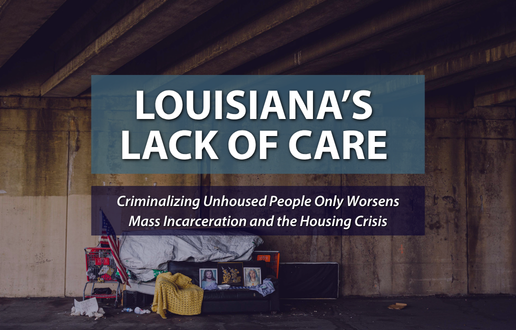
Louisiana’s Lack of Care
Criminalizing Unhoused People Only Worsens Mass Incarceration and the Housing Crisis
Amiyuh Tobias
June 9, 2026
Last November, for her 20th birthday, my little sister decided that—rather than a party—she wanted to pay for, package, and deliver meals to our unhoused community members in New Orleans rather than have a party or other celebration. She felt burdened by the thought of fellow human beings not having the privilege of a warm home and a hot meal to share with loved ones.
When going out to serve meals, we had the pleasure of sitting down and talking with unhoused people. Plenty of them were veterans. Some are employed, yet they are still unable to afford a home. (Louisiana has no policies that cap rent increases or control how often landlords can raise rent.) And those with criminal records expressed regret or have difficulty moving on from their past for a better life.
Far too many people had stories of getting sick and then being unable to work, thus losing their homes or going into debt from medical bills. Of course, we met individuals with drug and alcohol problems, but most of their issues started from a lack of support, resources, and guidance within their communities.
That wasn’t the first time I have spent time with unhoused members of my community. Every time I do so, I am met with the same stories of a failing society unwilling to create changes that could end the cycle of abuse, criminalization, neglect, and exploitation. Simply put, this speaks of a lack of care from our government (local and national) that can do the work to fix these issues, as well as our citizens who can demand it.
In my experience, Louisiana has historically prioritized law, order, and profit over the interests and wellbeing of its citizens. According to the Prison Policy Initiative, Louisiana’s incarceration rate is higher than any independent democratic country on earth. This includes detention centers, prisons, jails, and juvenile facilities. About 1 in 3 adults in the state have been imprisoned. Louisiana also legally requires incarcerated individuals to perform labor for little to no pay, basically an incentive for such high incarceration.
We associate crime with violence and danger. But when someone has been imprisoned, they go on to face significant barriers in employment, education, and housing. It is hard to rebuild one’s life. Yet, when we think of crime, we don’t think of those experiencing homelessness.
Louisiana lawmakers are currently advancing House Bill 211. It criminalizes unauthorized public camping by people who are unhoused. If taken in, individuals could be fined up to $500 and face up to six months in jail. If those two routes are not taken, then individuals can pay for 12-month treatment programs. Inability to pay for said programs allows for unpaid labor. Those who end up as repeat offenders will face higher fines and prison sentences. This will trap unhoused people in a cycle of convictions, court fees, and prolonged homelessness.
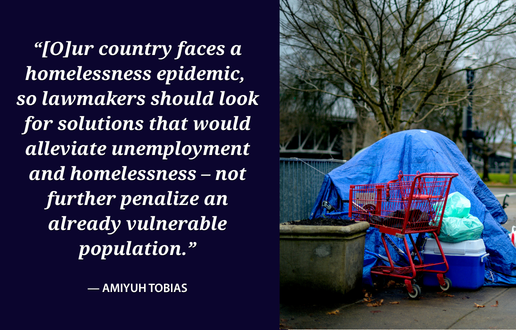
This is incredibly backwards. Our state and our country faces a homelessness epidemic, so lawmakers should look for solutions that would alleviate unemployment and homelessness – not further penalize an already vulnerable population. This ultimately increases the state’s far too large prison population.
Most Louisianians are so much closer to being in those positions than they realize. Yet our government chooses to go the punitive and carceral route instead of addressing root causes: shortage of affordable housing, surging property taxes and insurance premiums, and stagnate wages under the weight of inflation.
If the government is unwilling to create meaningful, beneficial change, then it is up to Louisianians themselves to push for it. Louisiana residents should contact their House Judiciary Committee members to let them know that their citizens do not consider homelessness a crime. We must call, email, or visit our local representatives to let them know that we will not continue to allow our government to criminalize us while simultaneously neglecting our needs.
Furthermore, we can point them toward solutions that would be more beneficial, such as the measures laid out in the bipartisan 21st Century ROAD to Housing Act, which was passed by the U.S. Senate in March and is now back in the House of Representatives to reconcile differences between the House and Senate versions before its final passage and being signed into law.
This bill would benefit not only to Louisiana citizens, but all people in the United States. It would improve disaster recovery, restrict large corporate investors from buying up single-family homes, and many other measures our government should be implementing instead of those found in House Bill 211, which will only hurt the community.
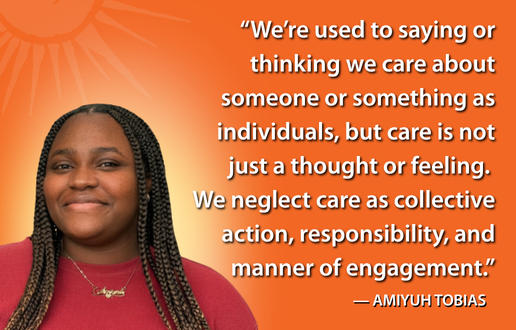
Most people lack empathy when it comes to homelessness, believing it is the consequences of one’s own actions that have led them to that point. We’re used to saying or thinking we care about someone or something as individuals, but care is not just a thought or feeling. We neglect care as collective action, responsibility, and manner of engagement. Like my little sister, we must seek this out intentionally, because we cannot say “I care” and then go on to make care-less decisions with our policies.
Amiyuh Tobias is a studen at Loyola University New Orleans and a Sr. Carol Coston, OP Fellow in NETWORK’s Young Advocates Leadership Lab (Y.A.L.L.).
